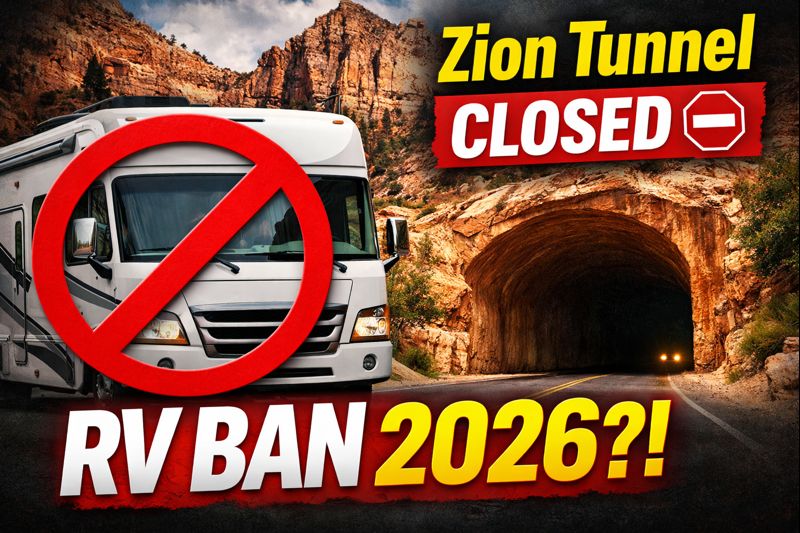

Starting in mid-2026, Zion National Park will implement a major traffic change known as the Zion Tunnel RV ban 2026. Under new rules set by the National Park Service (NPS), many oversized recreational vehicles (RVs), tour buses, trailers, and similar large vehicles will no longer be allowed to travel through the park’s main scenic route — the Zion-Mt. Carmel Highway — which includes the historic Zion-Mt. Carmel Tunnel.
This marks a significant shift for travelers planning Zion National Park road trips in 2026 and beyond, especially those hoping to drive their RVs through the heart of one of America’s most beloved parks. Below, you’ll find the most complete and detailed guide on what the Zion tunnel RV ban 2026 is, why it’s happening, how it will affect your trip, what routes and options remain available, and how you can plan around it.
🏞 What Is the Zion Tunnel RV Ban 2026?
The Zion Tunnel RV ban 2026 refers to a new National Park Service policy that will prohibit large RVs and oversized vehicles from using the Zion-Mt. Carmel Highway and its 1.1-mile tunnel will begin in mid-2026.
This policy will remove the previous system in which rangers provided escorted one-way traffic control for oversize vehicles through the narrow tunnel — a process that often disrupted traffic flow for park visitors and required extensive staff involvement. Under the new rule, vehicles that exceed specific size and weight limits will be directed to alternate routes outside of the park or around the main highway.
In short, if you own or are renting a large RV or oversized vehicle that exceeds the allowed dimensions, you will not be permitted to drive it through the Zion-Mt. The Carmel Highway tunnel is starting in 2026.
🚐 Zion Tunnel RV Ban 2026 – Size Restrictions You Need to Know
The dimensions that trigger the Zion Tunnel RV ban in 2026 are clearly defined. Vehicles will be banned from Zion-Mt. Carmel Highway and tunnel if they exceed any of the following parameters:
- Height: Taller than 11 feet 4 inches
- Width: Wider than 7 feet 10 inches (including mirrors and awnings)
- Length: Longer than 35 feet 9 inches
- Weight: Heavier than 50,000 pounds. When In Your State
These limits mean that many Class A motorhomes, large fifth-wheel trailers, and big tour buses — commonly used by RV travelers and group tours — will be affected by the ban.
🏛 Why Is the Zion Tunnel RV Ban 2026 Happening?
The Zion tunnel RV ban 2026 wasn’t imposed arbitrarily — it is the result of engineering, safety, and operational concerns that NPS and traffic officials have been studying for years.
🚧 1. Tunnel Size & Safety Limitations
The Zion-Mt. The Carmel Tunnel was constructed in the early 1930s, long before modern RVs, motorhomes, and large trailers became common. The narrow profile of the tunnel, combined with sharp curves and limited sightlines, increases the risk of collisions and lane crossing by larger vehicles.
🚘 2. Traffic Congestion & Delays
Today, dozens of oversized vehicles — including RVs — require special traffic escorts through the tunnel each day, often causing lengthy delays for other visitors. Some reports have indicated that these escort stops can amount to up to 50 times per day, necessitating wait times and bottlenecks for all park traffic.
🛠 Infrastructure Preservation
Constantly accommodating oversized vehicles places a strain on older bridges, road surfaces, and the tunnel structure itself. Restoration or expansion of the historic roadway would require major construction that could disrupt park ecosystems and degrade the park’s preserved historic character.
⚠️ Safety Enhancement
The new rule is intended to improve overall road safety for all visitors, reduce potential collisions, and free up park ranger resources that were previously required to escort oversized vehicles.
📏 What Vehicles Are Still Allowed Through the Tunnel?
Under the Zion tunnel RV ban 2026, smaller vehicles that do not exceed the size restrictions can still pass through the Zion-Mt. Carmel Highway and tunnel without having to use alternate routes. This includes:
- Smaller RVs and motorhomes that fall below the height, width, and length limits
- Camper vans and Class B RVs
- Pop-up campers and lightweight travel trailers
- Standard cars, SUVs, and trucks that meet the size criteria, When In Your State
However, any vehicle over the specified dimensions will be required to reroute outside the main highway.
📍 How the Ban Changes Travel Through Zion National Park
The Zion Tunnel RV ban 2026 alters one of the most scenic and historic drives in the park — the Zion-Mt. Carmel Highway — for big rigs. This route connects the eastern and south entrances of the park and passes through famous landmarks like the 1.1-mile tunnel and Checkerboard Mesa viewpoints.
Here’s how travel patterns will be impacted:
🚗 RVs and Oversized Vehicles
- Must take alternate routes around the park, outside of the main scenic highway
- Additional driving time may range from 10 to 45+ minutes, depending on the approach and destination.
- May still visit Zion, but must plan their approach differently
🚙 Smaller Vehicles
- Can still use the Zion-Mt. Carmel Highway and tunnel are within size limits
- Do not need to reroute around the park
🅿️ Parking & Shuttle Access
Oversized RVs can still be parked in designated overflow areas near the Zion Canyon Visitor Center or in Springdale, where travelers can use park shuttle systems to reach scenic points inside the park.
🗺 Alternate Routes for RVs After the Zion Tunnel RV Ban 2026
RV owners and tour operators who would normally travel through the Zion-Mt. Carmel Highway will need to use alternate routes around the park to connect their travel itinerary. Some options include:
🛣 1. Utah SR-59 from Hurricane to Arizona SR-389
This route bypasses the tunnel and connects to Utah-Arizona border roads with scenic, less congested travel.
🛣 2. Utah SR-14 from Cedar City
A scenic mountain route that avoids Zion entirely and connects to other Southern Utah destinations.
🛣 3. Other Secondary Highways Around the Park
Routes like SR-20 and others provide alternate approaches for oversized traffic wanting to reach Springdale or Zion’s main canyon area without using the restricted highway.
These detours are typically longer and may involve steeper grades, but they allow RV travelers to continue their trip without violating the Zion tunnel RV ban 2026.
🕰 How the Zion Tunnel RV Ban 2026 Affects Trip Planning
Travelers planning to visit Zion National Park in 2026 should consider the changes brought by the Zion tunnel RV ban 2026:
🧭 1. Allow Extra Driving Time
Due to rerouting and potential traffic, plan additional travel time if approaching from Bryce Canyon, Las Vegas, or other popular routes.
🏕 2. Book Campgrounds Carefully
RVs can still camp in designated areas, but may not reach certain locations that were previously accessible via the tunnel route. Planning ensures smoother logistics.
🚐 3. Measure Your Vehicle
Make sure your RV or camper dimensions comply with Zion’s size requirements before attempting to use the scenic highway.
🚌 4. Consider Shuttle or Park Transit
Parking an RV at an entry point and using shuttle systems can be a practical way to explore Zion’s iconic sites without worrying about vehicle restrictions.
📊 What This Means for Tourism & Local Businesses
The Zion Tunnel RV ban 2026 has sparked mixed reactions:
👍 Benefits
- Increased roadway and tunnel safety
- Reduced traffic congestion on the historic highway
- Better visitor experience for most park visitors
- Reduced ranger resource strain Tarotogel
👎 Concerns
- RV travelers may find their routes longer and less convenient
- Local businesses reliant on large tour groups may need to adapt to KSUT
- Some visitors may skip Zion if RV access becomes too complex
Local community leaders, however, believe that the impact will normalize as travelers adapt and alternative routes are understood.
📚 Zion Tunnel RV Ban 2026 Timeline
- Pre-2026: Oversized vehicles were allowed with escort through the tunnel under strict limits.
- Mid-2026: Full implementation of the Zion tunnel RV ban 2026 begins — large vehicles rerouted off Zion-Mt. Carmel Highway.
- Post-2026: New travel norms apply for RVs and oversized vehicles entering Zion.
🚙 Practical Tips for RV Travelers After 2026
✔ Check your vehicle’s exact width, height, length, and weight
✔ Study alternate route maps before departure
✔ Arrive early to secure RV parking near visitor centers
✔ Use park shuttle services where available
✔ Consider splitting your trip with a car for narrow scenic drives

FAQs
1. When will the new vehicle restriction take effect?
The restriction is scheduled to begin in mid-2026, with exact dates announced by park authorities closer to implementation.
2. Which vehicles will be affected by the new rule?
Large motorhomes, oversized RVs, tour buses, and vehicles exceeding specific height, width, length, or weight limits will be affected.
3. Are small camper vans still allowed?
Yes, smaller camper vans and vehicles that fall within the permitted size limits can still use the scenic highway.
4. Why was this decision made by park officials?
The decision was made to improve road safety, reduce traffic congestion, and protect historic infrastructure.
5. Will this change affect regular cars and SUVs?
No, standard cars, SUVs, and pickup trucks that meet size requirements will not be impacted.
6. Can oversized vehicles still visit the park?
Yes, larger vehicles can still visit the park, but must use alternative routes or park outside and use shuttle services.
7. Are guided tour buses included in the restriction?
Yes, large tour buses that exceed the allowed dimensions will no longer be permitted on the restricted highway.
8. Is the tunnel considered historically significant?
Yes, the tunnel was built in the 1930s and is considered an important historic and engineering landmark.
9. Will traffic congestion decrease after the rule is enforced?
Park officials expect smoother traffic flow and fewer delays once escort requirements for large vehicles are eliminated.
10. Are there alternate routes available for large vehicles?
Yes, several state highways and scenic bypass routes around the park can be used by oversized vehicles.
11. Will this affect campground access inside the park?
Some campgrounds may be harder to reach directly for large vehicles, requiring additional planning.
12. Can travelers park large vehicles and use shuttles instead?
Yes, parking outside the restricted area and using shuttle systems is a recommended optio
13. Does this rule apply year-round?
Yes, once implemented, the restriction will apply throughout the year unless otherwise announced.
14. Will fines be issued for non-compliance?
Vehicles that attempt to enter restricted areas without meeting size requirements may face penalties or be turned back.
15. Is this type of restriction common in national parks?
Yes, many national parks impose vehicle size limits to protect roads, wildlife, and visitor safety.
🏁 Conclusion
The Zion Tunnel RV ban 2026 marks a major milestone in how visitors — especially RV owners — navigate Zion National Park’s historic roadways. While large vehicles will no longer pass through the scenic Zion-Mt. Carmel Highway and the landmark tunnel, the changes are designed to improve safety, reduce congestion, preserve infrastructure, and enhance the overall visitor experience
For RV travelers and tour planners, understanding and preparing for these rules is essential to enjoying Zion’s natural wonders in 2026 and beyond. With alternate routes, shuttle systems, and thoughtful planning, you can still experience everything Zion has to offer — even with the new Zion tunnel RV ban 2026 in place.


